

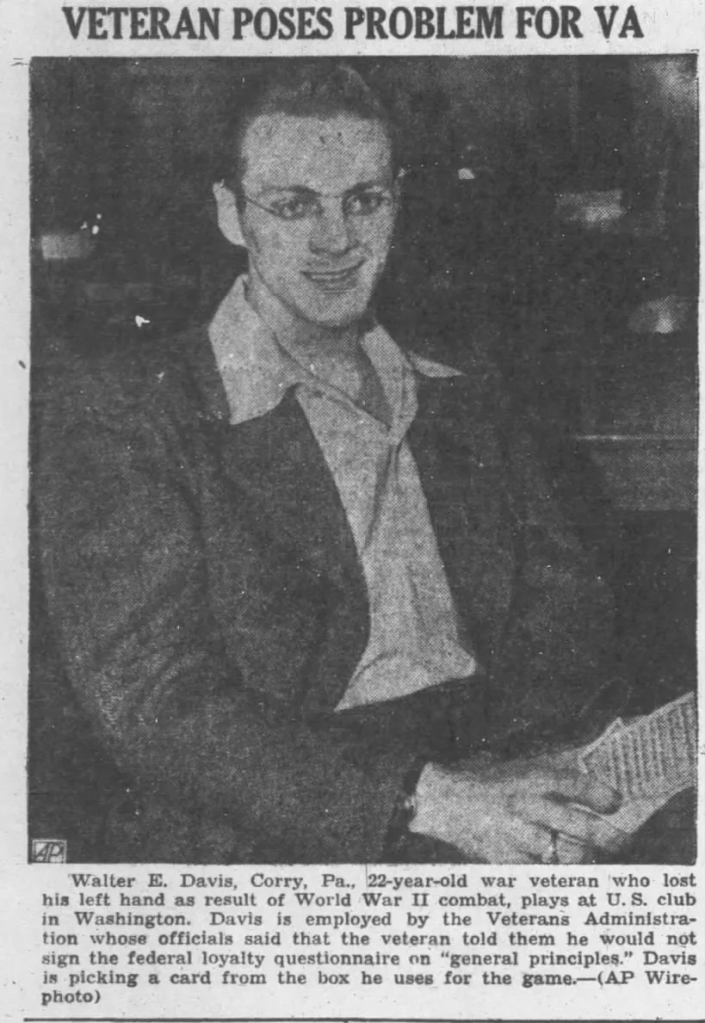
“What is loyalty? They can investigate me from here to Heaven and they won’t find any blemishes. I’m as loyal as any American, maybe more so,” said Walter Davis, World War II Army veteran and employee of the Veterans Administration who refused to sign the federal loyalty questionnaire required of all VA employees in 1947.
Davis, a Purple Heart recipient who died July 19, 1999, and whose remains are in Lawn Cemetery in Beaver Dam, Pennsylvania was wounded in both France and Germany, losing his left hand in clashes along the Siegfried Line. Davis lost a brother in Okinawa and an uncle in the Battle of the Bulge.
On December 1 and 2, 1947, newspapers across the country carried a photo, often on the front page, of Davis playing cards with the following caption: “Walter E. Davis of Corry, Pa., a 22-year-old war veteran who lost his left hand as a result of World War II combat, plays at a USO club in Washington. Davis is employed by the Veterans Administration whose officials said the veteran would not sign the federal loyalty questionnaire on ‘general principles.’ Davis is picking a card from the box he uses for the game.”
On December 5, 1947, acclaimed war-journalist Kenneth L. Dixon wrote that the loyalty questionnaire was one element in a “campaign of hysteria which has been threatening to ‘burn down’ the civil rights structure of our American government recently just to smoke out a few Communists who probably would go unnoticed in the very confusion of that campaign.”
For his part, Walter Davis said “I don’t think Communists should be permitted to work for the government. But I didn’t fight for a government which tells you to ‘sign this, or else.’ That’s what I thought we were fighting to prevent. I fought for some rights – I think those rights have been stepped on.” At the risk of losing his job, the blond, bespectacled 22-year-old Davis refused to sign.
According to journalist Dixon the only thing the loyalty questionnaire business accomplished was “the frightening of thousands of decent, ordinary, and often underpaid, federal employees who now are afraid to speak their opinions in departmental lunchrooms, and who literally tremble at nocturnal knocks on their door in a manner reminiscent of an erstwhile enemy regime abroad.”
Addressing the Davis situation directly, Dixon writes “It is pointless to stress the irony of questioning the loyalty of a twice-wounded, one-handed veteran who is listed on the Army books as one hundred percent disabled. It is equally pointless to underscore the stupidity of expecting a disloyal person to admit openly or even carelessly give away his treason in this sort of mass questionnaire. The point is that Walt Davis suddenly made a lot of people stop and think.”
The controversy surrounding his refusal to sign the document was short-lived as Walter agreed to the pledge on December 10.
On December 11, 1947, Congressman John E. Rankin of Mississippi, whose physical description of Davis shows they never met, addressed the U.S. House of Representatives: “Mr. Speaker, several days ago Mr. Walter E. Davis, a young veteran, an amputee, who I believe lost a leg in the recent war, refused to take the anti-Communist oath as an employee of the Veterans Administration. He later found that the Communists were trying to make a goat of him, that they were using his refusal as propaganda throughout the country. So, on yesterday, rather than be made the tool of the Communist forces in the country, he went back, took the oath, and issued this statement (at this time, Congressman Rankin introduced a newspaper article that carried the following testimony of Davis):
“Since stating my position relative to the loyalty probe and my refusal to sign the loyalty pledge it has been brought to my attention that disloyal groups are attempting to make capital of my actions. For that reason, and only for that reason, I am anxious to have my fellow Americans know my true position. I felt at the time I was asked to sign the pledge as a Federal employee, and I still feel that the loyalty of anyone who fought and bled for his country should not be questioned. However, I was unaware of the forces at work to undermine our form of government. In no other way could I, just a plain Joe, have seen how quickly the enemies within our gates could attempt to use me as a tool to agitate and cause unrest. It is with pleasure that I now welcome the opportunity to sign the loyalty pledge and do anything else that may root out of our Federal Government and make known to our people any among us who are disloyal.”
Rankin continued, “I congratulate this young man for coming out and supporting his government. The loyalty pledge is not intended to embarrass anyone and will not embarrass any real American when he understands it.”
Eleven years later, in 1958, Davis again made national news when he appeared in a May 28 Associated Press Wirephoto; this time pictured in the US Capitol rotunda with the following caption: “Walter Davis, Pennsylvania farmer who lost an arm fighting in the European theater in the last war stands at attention before the flag-draped caskets containing the bodies of Unknowns of World War II and Korea in the Capitol rotunda today. Davis, of Corry, Pa., was the first man in line to pay tribute to the Unknowns. ‘It’s beautiful, it’s beautiful,’ he said.”

 James K. Hanna