
Introduction
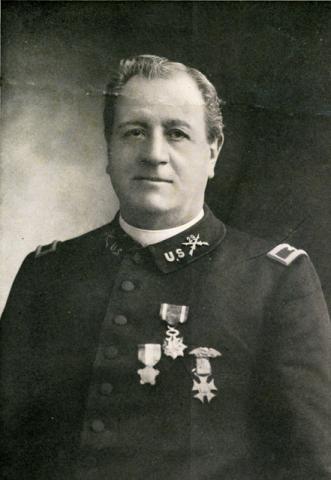
He was regularly praised by several U.S. Presidents with William McKinley saying on one occasion in a public speech that “the American Catholic Church can point with proud exultation to that noble type of priest and patriot – Father Edward Vattmann.”[i]
Following his death, the Catholic Telegraph, the newspaper of the Archdiocese of Cincinnati, carried a front page column datelined Chicago: “At the entrance to the soldiers’ cemetery at Fort Sheridan stands a handsome monument destined to preserve the memory of Right Reverend E. J. Vattman, the first chaplain of the United States Army to attain the rank of Major. At the foot of the cross is inscribed, “The Flag and the Cross.” Below are inscribed the words ‘Monsignor Vattman was a lover of humanity.’”[ii] Contributors to the memorial included the Theodore Roosevelt family and William Howard Taft.[iii]
Vattmann was, as the marble memorial states, a lover of humanity and that love was reflected in the body of his life’s work. William Zinsser, quoting J. P. Morgan in Extraordinary Lives, wrote: “There are two reasons why a man does anything. There is the good reason, and there is the real reason.” Edward Vattmann’s life was animated by the virtues of honesty, courage, and integrity, all of which underscore the “real reasons” for all he did.
In moments that required decisive action he had ready answers such as “Leave it to me!” and “You don’t argue with a mob, you command them!” and “I know how to settle it!” He was a take-charge man who achieved his desired end, always to benefit others.
The essence of his service to God and Country as a priest and military chaplain is captured in a letter written to him by Theodore Roosevelt in December of 1916:
No Christmas greeting that I have received, not even that from Cardinal Gibbons, has touched and pleased me more than yours. You have been a good soldier and a good priest; a most useful citizen and one of the staunchest of American patriots, and in addition a true and loyal friend. What higher praise can be given any man? [iv]
At the time they had known each other fourteen years. The twenty-sixth President was just one of many admirers, not all highly placed, as found in the editorial in the Army & Navy Journal published in 1904 when, after fifteen years of active duty he retired with the rank of Major from the U.S. Army:
Probably no Army chaplain ever left the active service more beloved by the officers and men with whom he was associated or with a larger record of usefulness. The record of his services conforms to the highest ideals of the Army chaplain and discloses an example for those who succeed him.[v]
We know little of his early life as he was about twenty when the record begins[vi] and he was twenty-five when, in 1864, on the twelfth of December he left Prussia, sailed for America, and arrived in New York on New Year’s Day. Six months later, on July 1, 1865, he was ordained a priest of the Diocese of St. Louis, Missouri, and embarked on a career of more than fifty years of zealous labor for Church and Country.
His fifteen-year record as an active-duty army chaplain beginning in 1891 was preceded by twenty-five years’ service as a parish priest in the rural Midwest and followed by thirteen years of civic engagement.
In 1880, he became the first Catholic chaplain appointed to the U.S. Army following the Civil War, but not the first to serve: he declined the appointment of President Rutherford B. Hayes but accepted an appointment by President Benjamin Harrison ten years later.
From nineteenth century rural Ohio to emerging Texas in the early twentieth century; from South Dakota to the Philippines to the Great Labor Strike in Chicago in 1904; from the burial of President McKinley to the attempted assassination of Teddy Roosevelt, Father Vattmann was on duty and serving with extraordinary courage and resolve.
After retiring from the military, he was actively engaged first, in the Bureau of Insular Affairs, and later, the Catholic Colonization Society while finding time to contribute in great measure to the civic affairs of Wilmette, Illinois, his adopted hometown.
He knew McKinley, three years younger, from his early days in Ohio when the two were in their thirties. As they matured in their careers so did their relationship. In later years, as pastor of SS. Philip and James Church in Canal Fulton he often hosted McKinley overnight when the president traveled to Cleveland to visit their mutual friend Senator Mark Hanna. And McKinley, when in need of a respite, would spend quiet weekends at Vattmann’s rectory, so often that he purchased and placed a bed in the home. Father John Maurer (1888-1962), pastor of SS. Philip and James from 1934 to 1962, recalled that the bed was still in the rectory and was “the first thing I was told about when I came here.”[vii] Maurer was also told of Father Vattmann’s visit to McKinley’s bedside prior to his death and that Vattmann, after the president died, remarked “They can do what they want with his body; I have taken care of his soul.”[viii]
His travels were widespread: from Westphalia to Wisconsin to the Black Hills of South Dakota; from northern Ohio to Manila, and from Rome to Washington; to Kentucky, Florida, Chicago, and Texas where a town was named after him.
Everything about the man was expansive: he understood Greek and Hebrew, and in addition to English and his native German, spoke Latin, French, Italian and was so considerable in physical stature that when serving in South Dakota, the Sioux, whose respect he enjoyed, nicknamed him Wazi Tanki or “Large Pine Tree.”
During the labor riots in Chicago in 1894, in peril of his life, he mounted a freight car, faced thousands of furious people, and exhorted them to disperse, later proclaiming, “You don’t argue with a mob, you command them!”
When asked in 1902 by President Roosevelt to go to the Philippines on a fact-finding mission he went without hesitation and his conclusions were essential in settling both secular and religious disputes following the War with Spain. After delivering his report to Roosevelt, Cardinal Gibbons insisted he take his findings to Rome and present them to the Vatican.
He died in 1919 in Wilmette at the age of seventy-nine. Prior to his death The Salesianum acknowledged his life’s work and dedication to church and country: “The fruits of half a century of unceasing toil laid beneath the Cross and Flag. That is the record of the Very Reverend. Edward Vattmann, Major, Chaplain of the U.S. Army.”[ix]
In the pages that follow, readers will find a deeper dig into this remarkable life – a life fit for an adventure movie. From mission churches in the Midwest to the sad saga of Wounded Knee; from diplomatic assignments to the Papal Household of Benedict XV; from young immigrant seminarian to adviser to presidents; this is Edward Vattmann’s story, the story of a man – a man in all force of the term.
[i] The Catholic Telegraph, Volume LXXXIV, Number 18, May 6, 1915, 1.
[ii] “Catholic News Service – Newsfeeds, 28 June 1920.” Catholic News Service – Newsfeeds, June 1920. JSTOR, https://jstor.org/stable/community.32136620. Accessed 29 Mar. 2023.
[iii] Wilmette Historical Museum, Introductory Materials, brief biography, 7.
[iv] Letter from T. Roosevelt to Vattmann, dated “Xmas, 1916.” Wilmette Historical Museum.
[v] Editorial, Army & Navy Journal, September 17, 1904, Diocese of Cleveland Archives.
[vi] A search of Ancestry.com reveals a half-sister, Emilie Vattman, born in 1860 in Germany with no information on parents or any other siblings.
[vii] Introductory Materials, Edward Joseph Vattmann, Wilmette Historical Museum, 52.
[viii] Ibid.
[ix] The Salesianum, Vol. 10, No. 4, July 1915. The Alumni Association of St. Francis Seminary, St. Francis, Wisconsin, 7274.
 James K. Hanna