
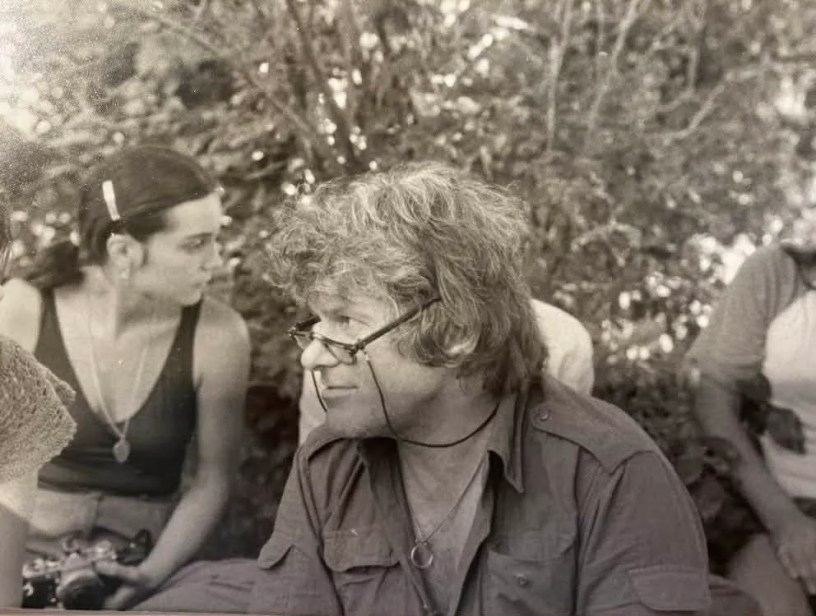
“Sometimes hell is a good place—if it proves to one that because it exists, so must its opposite, heaven, exist. And what was that heaven? Poetry.” —Gregory Corso on life in prison
Baptized Nuncio Corso at birth, he later changed his name to Gregory. When abandoned by his mother and father at age one he was given over to the care of Catholic charities. Gregory Corso lived to age 70, dying of prostate cancer in Minneapolis on January 18, 2001. His death drew international headlines.
The banner in The Vancouver Sun read, “Poet was Last Literary Hero of Beat Generation.”
The San Francisco Chronicle called Corso the “Last of the Beat Triumvirate,” linking him to Allen Ginsberg and Jack Kerouac.
Two headlines that best captured the essence of the man appeared oceans apart on separate continents. The Indianapolis Star recalled him as “Beat generation poet Gregory Corso, known for his passion for language,” and the Daily Telegraph of London led with “Gregory Corso, American poet of the 1950s ‘Beat’ generation whose work was more disciplined than that of Allen Ginsberg and William Burroughs.”
Last of the Beats, a literary hero with a disciplined passion for language. Heady Stuff.
Corso produced more than a dozen collections including Gasoline (1958), The Happy Birthday of Death (1960), Elegiac Feelings America (1970), and Mindfield (1989).
His first, The Vestal Lady on Brattle, was underwritten by a group of student admirers at Harvard in 1955, and in 2022, The Golden Dot: The Last Poems 1997-2000 was published posthumously.
When Gasoline was published in 1958 by City Lights (Number Eight, The Pocket Poets Series) Jack Kerouac’s blurb appeared on the back cover. “Gregory was a tough young kid from the Lower East Side who rose like an angel over the rooftops and sang Italian songs as sweet as Caruso and Sinatra, but in words. ‘Sweet Milanese hills’ brood in his Renaissance soul, evening is coming on the hills. Amazing and beautiful, Gregory Corso, the one and only Gregory, the Herald.”
A tough kid, yes, but that doesn’t capture the real picture of his hardscrabble youth—and neither does hardscrabble. No words suffice.
Born to teenage parents in New York City in 1930, his mother and father separated within the year, leading to—as The Vancouver Sun reported— “a painful childhood in and out of orphanages and foster homes, hard in every way imaginable.”
“The trauma hits you,” he told interviewer Michael Andre in 1972, “and you can’t get away from it I’ve been told, if you are one year old and your mother leaves you. Especially because I had the double whammy. They gave me to a woman who I thought was my mother, and took me away from her, because she wanted to keep me, and they didn’t want that because my father said eventually, he’d take me back, which was ten years later. That’s a double whammy there, and I had no realization of it.’’
In a 1974 interview he told Robert King, “From “One to 10, I had eight mothers, because I didn’t have my mother; they sent me to all these orphanages and foster homes. Ten to 17 were funny years because 16 and a half—prison, 13—bad boy’s home, so from 10 to 17—institutional; out on the streets when I was 20 years old. I slept on the rooftops and in subways of New York, man. I had no home. From 11 years old to 16 and a half.”
At thirteen he had a moment of grace and clarity. “I did not know how to write a poem when I felt I wanted to be a poet. I was thirteen years old and alone in the world—no mother and my father was at war. I belonged to the streets and no school did I attend. To exist I stole minor things and to sleep I slept on the rooftops and in the subways of the city, the big wild city of New York in 1943. I went through a strange hell that year and I guess it is just such hells that give birth to the poet. There swelled in me at that time some inexpressible joy and sorrow; I wanted to tell the whole world about it but just didn’t know how.”
Corso spoke frequently of his time in New York’s Clinton Prison from age 17 to 20, but less often of his earlier incarcerations in Manhattan’s House of Detention, also known as “The Tombs,” and elsewhere. Details of those early teen years remain obscure but in Riding Pegasus Bareback, biographer Gregory Stephenson uncovered little-known pieces of the future poet’s early misadventures.
According to Stephenson, the 16 year old was in Vermont working at a ski lift where, after an arrest for stealing money and clothing from a boarding house in Manchester, he was sentenced to serve time at Weeks Industrial School in Vergennes, Vermont.
Within a month he escaped from Vergennes, committed new crimes on the run and was soon captured. In addition to the escape, he was charged with grand larceny and sentenced to serve more time at Weeks. However, additional charges from the escape were later filed, including breaking and entering, leading to a new sentence, sending him to Windsor State Prison, with a sentence of four to six months.
The time served had little effect on Coros’s mindset as on release from Windsor, he and three accomplices took crime to the “scientific level.” They purchased four World War II walkie-talkies from an Army-Navy surplus store and used them to communicate while robbing a Household Finance office. The four got away with $21,000. Corso fled south but when the others were caught in New York, they gave him up and he was arrested in Florida. “That’s how I got to prison for three years,” he told King, “Because (by using the walkie-talkies) the judge said I was putting crime on a scientific basis.”
His three-year sentence to Clinton Prison in Dannemora, New York beginning in 1948 led to his conversion to civility, and while an example of rehabilitation, it moreover is a unique story of personal transformation. It was, as Corso recalled in 1964, “one of the greatest things that ever happened to me.”
(It is widely believed that at Clinton, Corso occupied the same cell which Charles “Lucky” Luciano had just vacated.)
“I was not hampered by the undeveloped and ofttimes silly consciousness of youth; in prison I had to deal with men, all kinds of men, caught in a single fate, and with time, three years if it. One man told me ‘Boy, don’t you serve time, let time serve you.’ In that time, I read many great books and spoke to many amazing minds—men who had spent many years on Death Row and had been reprieved—one can never forget talking to such souls.”
Chief among the many masterpieces Corso absorbed was a simple dictionary. “My vocabulary that I obtained was from a standard dictionary of 1905, that big, when I was in prison. For three lucky years I just got that whole book in me, all the obsolete and archaic words. And through that I knew I was in love with language and vocabulary, because the words and the way they sounded, and what they meant, how they were defined and all that, I tried to revive them, and I did,” he told interviewer Michael Andre in 1972.
Corso did not write poems in prison, but on release he began to write. “I did not write poems about prison or prison men. I wrote about the world outside because I was once again outside with the world. I was of the world, not of prison. In prison I only learned, I did not write. If one must climb a ladder to reach a height and from that height see, then it was best to write about what you see and not about how you climbed. Prison to me was such a ladder.”
“When I left prison one man told me, “When you’re talking to six people, make sure you see seven. In other words, ‘dig yourself.”
Corso, free, digging himself, educated and transformed by three years of reading masterpieces and a dictionary, made his way back to New York and Greenwich Village, where, at a watering hole named The Pony Stable—in one of the most consequential random meetings in the annals of Twentieth Century literature—he ran into a guy named Allen Ginsberg, who introduced him to a fellow named Jack Kerouac.
The rest is, as they say, history.
 James K. Hanna