
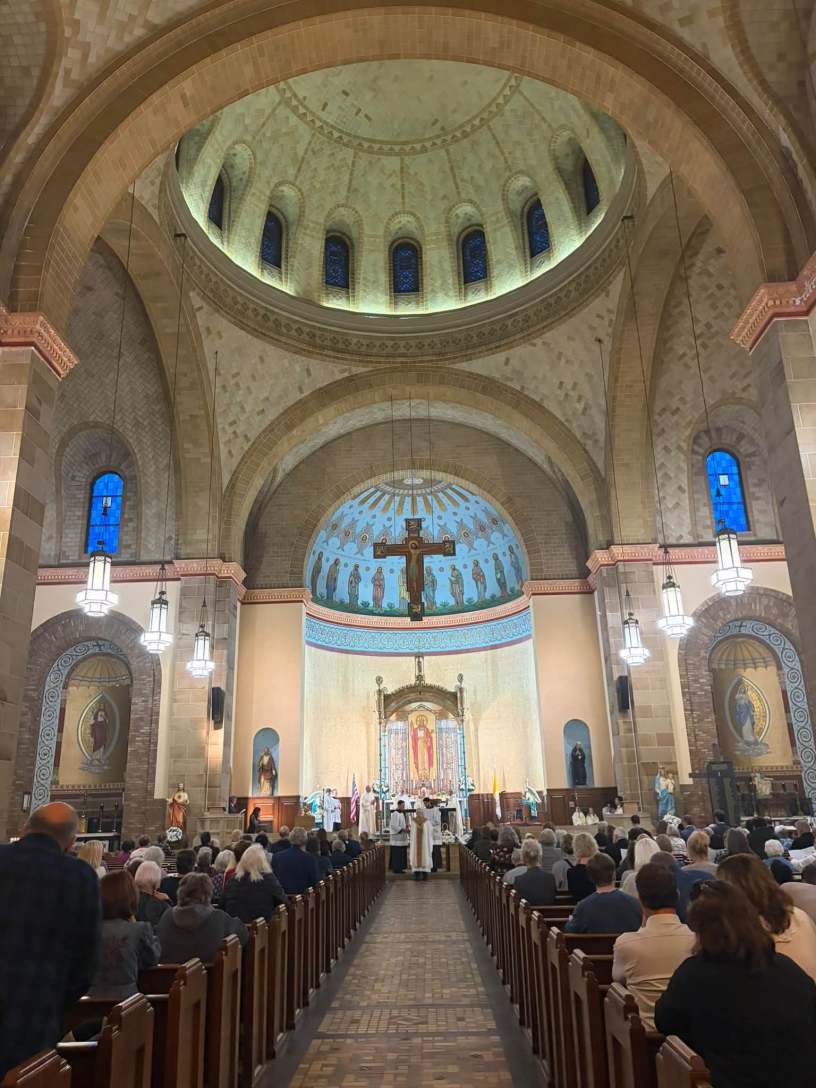
Saint Boniface Church in Pittsburgh celebrated its centennial anniversary this weekend. It narrowly escaped the wrecking ball of “urban development.” It was an honor to be asked to write a brief history of this National Historic Landmark.
A Sense of Permanence: A Brief History of St. Boniface Church
by James K. Hanna
“Churches provide a symbolic corpus of the mystery of faith, of the mysteries of God and provide a key to access them by passing from the visible to the invisible.”—Maurice Dilasser
A New Stronghold of Prayer in 1926
A tidal wave of praise and commendation rose high and wide one hundred years ago when construction of St. Boniface Church was completed in 1926. The Pittsburgh Press led the way, proclaiming on its front page, “One of the latest and most interesting additions to Pittsburgh’s splendid ecclesiastical architecture is the beautiful new St. Boniface Church on East St., Northside,” adding, “For those unable to visit Italy personally, this church offers the opportunity to know intimately that great period of Italian architecture known as Romanesque.”[1]
Built to meet the needs of the growing parish originally established in 1884,[2] the church seating 850 and costing $260,000 ($4.85 million in today’s dollars) was dedicated on Thursday, November 25, 1926 by Bishop Hugh C. Boyle.[3]
The structure was the third to serve the parish named for the English Benedictine monk who led the Anglo-Saxon mission to the Germanic parts of Francia during the eighth century. The first sanctuary was a chapel built to serve approximately sixty families that formed the genesis of the parish. It was replaced with a church, dedicated in 1889, that saw expansion and improvements as the parish grew to 360 families in 1892. [4]
It was a joyous occasion when, on November 25, 1926, the present church was dedicated; the day fulfilling the dreams of parishioners and of Father Boniface Wirtner, OSB, pastor since 1912. Though Father Wirtner retired in 1924 due to ill health, he lived to see his vision realized after passing the torch to Father Robert Wepfer, OSB who steered the project to completion.
Following the dedication, a solemn High Mass was said by Father Wepfer, who coincidentally was also celebrating the twenty-fifth anniversary of his ordination. He was assisted by Father Roman Nibler of Johnstown, and Father Felix Fellon. OSB, of St. Vincent Archabbey. Bishop Boyle, St. Vincent’s Archabbot Aurelius Stehle, and Monsignor Fitzpatrick Corzynski were also in the sanctuary. Father Otto Wendell of St. Vincent Archabbey was master of ceremonies. The homily was preached by Father Virgil Niesslein of St. Benedict’s Church, Covington, Kentucky.
The liturgical celebration continued with Vespers Thursday evening led by Archabbot Stehle, and on Friday morning a solemn pontifical mass was said for the deceased pastors, members, and benefactors of St. Boniface parish. Archabbot Stehle was celebrant.[5]
It was the culmination of a construction effort that began on July 1, 1925, with the cornerstone being laid on October 18 the same year.
Designed by Pittsburgh architects, A. F. Link[6] and Associates, and built by Duquesne Construction and several sub-contractors, the church is constructed entirely of stone, reflecting traditional skills of masonry. Its chief glory is the fifty-two-foot-wide dome resting on spherical triangles. Ninety-four feet from the floor, the dome’s sacred character is enhanced by a circle of sixteen prism-stained glass windows of reds, blues, greens, and Christal inlays, featuring the twelve apostles and four evangelists. The symbolic language is both rich and subtle.
The First Forty-Five Years 1926-1971
For the next forty-five years the parish flourished in its new church, with Father Wepner continuing as pastor until 1956. During this time, the church survived four fires.
The first, in 1939 was caused by an overheated furnace, the greatest damage of which seems to be that it routed a meeting of the Ladies Aid Society. The second, in 1944, began in the basement of the adjoining school, causing $5,000 damage.
Two years later, in 1946, a loss was suffered, the result of a fire that began in in a Christmas creche, destroying a $12,000 side altar made of Italian marble.
The most troubling fire occurred in February 1954, when a 24-year-old truck driver from Canton, Ohio was cleared of arson charges in a jury trial when he claimed he accidentally started a fire that resulted in $30,000 damage[7] to ten pews and four lockers in the altar boy’s locker room in the sacristy. The suspect claimed he entered the church at 3:30 in the morning seeking a warm place, lit a match and a newspaper to light his way, dropping it, causing fire to spread.[8] His attorney argued that the man was no more to blame than Mrs. O’Leary’s famous cow which kicked over a lamp and started the great Chicago fire of 1871. The incident forced the parish to celebrate Mass in the convent.[9]
Fr. Wepfer was succeeded by Father Dominic Breuus, OSB in 1956, and Father Stepehen Wendell OSB in 1963. Father Norbert Rupprecht, OSB was named pastor in 1969. It was on Father Rupprecht’s shoulders that a series of challenges fell, trials that very nearly brought the wrecking ball to bear on the walls of the great and beautiful church, which, at the time, was less than fifty years old.
The Valley of Indecision
In the 1970s the East Street Valley became a valley of indecision as the Federal Highway Administration (FHA) and Pennsylvania Department of Transportation (PennDOT) contemplated construction of a major highway in the corridor. The on-again, off-again plan for a limited-access road connecting downtown with Interstate 79 north of the city caused angst for the diocese and parishioners and neighbors of St. Boniface.
In 1971 PennDOT made a “Declaration of Take” under Eminent Domain provisions, a decision calling for the sale of the church to PennDOT, but the decade dragged on. The state wanted to tear it down. The diocese wanted to close it, branding St. Boniface as “an aging parish in a diminishing community.”[10] The diocese had been planning to consolidate it with two others, St. Cyprian and St. Mary, into a new building on the Northside.
The church and property were sold to PennDOT in 1971 for $1,971,950.[11] The proceeds to be held in trust for use by the parish.
In the interim, St. Boniface remained open, renting the church from PennDOT for $700 monthly. At first, some parishioners resigned themselves to eventually losing their beloved building, but as the years passed, St. Boniface Church became a symbol of struggle for strong-willed parishioners.
In 1973, the mayor of Pittsburgh, Pete Flaherty, made a proposal, called the “Compromise Plan” to PennDOT that permitted the church to remain and yet allowed the highway to be accommodated. The plan was never implemented but it did give parishioners hope that an alternative to destruction could be found.
It was then that many dedicated parishioners and others led by Father Rupprecht, Martin Kraus, and Arcadi Nebolsine, began to work to save the church from destruction.[12] Their first success came in 1974 when the Pittsburgh History & Landmarks Foundation, having begun a Historic Landmark plaque program in 1968 to identify architecturally significant structures, acknowledged the church as a significant part of our local heritage though the designation does not protect a building from alteration or demolition.[13]
It was an important and hopeful step, one that contributed to a decision, in 1975, by PennDOT to offer to sell the property back to the diocese. Diocesan officials refused the offer.
On May 28, 1975, The Pittsburgh Post Gazette reported below the headline ‘Wrecking Ball in the Future of St. Boniface,” that the diocese was holding firm on its decision of March 29, 1974 to abandon St. Boniface, citing the shifting Catholic population of the area and noting “the number of families (belonging to the parish) has dropped from more than 900 at its peak to 525 in 1965, and to below 350 at its present time.”[14]
At the same time, the diocese did however ask the state to hold off demolition for two years.
By 1976 East Street had become, according to Pittsburgh Press columnist Roy McHugh, “a thoroughfare of weed grown vacant lots, of houses standing empty, of boarded up buildings. The politicians and bureaucrats have turned it into an urban desert.”[15] McHugh’s commentary appeared one day after St. Boniface celebrated its Golden Anniversary. “One landmark endures,” he wrote. “St. Boniface Church., doomed but still there, a Byzantine-Romanesque symbol of resistance to the wrecking ball.”
In March of 1977 parishioners received official word from diocesan officials that they would have to vacate the premises by June 1. When appeals by parishioners to diocesan officials and to the Vatican to save St. Boniface failed, they and other interested parties sought to have the church designated a historic landmark. In that effort, it was on May 25 that two busloads of parishioners and others went to Washington DC to meet with officials of the Department of the Interior.
The Crusade to Save the Church
The effort proved fruitful, as on June 1, 1977, Dr. William Murtaugh, Keeper of the National Historic Register, personally visited St. Boniface and declared the structure eligible for listing on the National Register of Historic Buildings. Orders had already been received from diocesan officials to remove the windows and other items of value. Within days, these orders were cancelled pending solution of the federal decision.[16]
On June 21, 1978, St. Boniface was officially declared of historic significance and added to the National Register of Historic Places.
For all practical purposes, this ended the struggle to save St. Boniface Church.
The designation led the FHA and PennDOT to propose a plan to spare St. Boniface from the wrecking ball. The proposal placed the highway 85 feet from the church steps and fifty feet atop a landfill above the valley floor.
The designation and revised highway plan meant only that the structure would not be razed. Father Norbert Rupprecht, pastor, long an advocate for saving the church, told reporters, “Now we have to see what we can do with the bishop.”[17]
With the church spared from the wrecking ball, newspapers reported in December of 1979 that the state legislature had approved a bill allowing PennDOT to sell the property even though it had acquired it through eminent domain. The resolution also carried the caveat that PennDOT first offered the property to the diocese, though, at the time, the diocese was continuing to say it was not interested.[18]
On November 11, 1981, PennDOT finally purchased the last parcel needed to begin construction of the expressway, property along Hazlett Street north of St. Boniface.[19]
In 1981, PennDOT finally offered to sell the property back to the diocese for a reported $590,000.[20] “By then,” The Pittsburgh Press reported, “most of the homes and businesses in the East Street Valley had disappeared, bought and torn down by PennDOT, leaving the once-bustling ethnic neighborhood resembling a bombed-out valley.”[21] In all, 1,700 homes were razed.[22]
On June 29, 1982, reports in the local press announced that diocesan officials had approved the repurchase of St. Boniface from PennDOT in the amount of $590,000, allowing the church to make a profit of nearly $1.5 million, however, as Auxiliary Bishop Bosco stated at the time, that figure does not amount to a windfall. “It will be up to the congregation to maintain the building, and that at times could be very costly; and as a historic landmark any repairs would have to be first approved” by the appropriate agencies.[23]
Pittsburgh Post-Gazette columnist Don Miller wrote “Congratulations to the congregation of St. Boniface Roman Catholic Church, East Street, on buying back this beautiful edifice from PennDOT. It is significant that the church was purchased for much less than the diocese sold it for. But the important point is, the church remains the only handsome structure in the East Street valley. Many were prepared to face bulldozers with bare hands if necessary. Thanks to reason and public pressure, this was not necessary. The names of Rev. Norbert Rupprecht, interested friends Martin Krauss and Arcadi Nebolsine, as well as loyal parishioners, are inscribed in many hearts.”[24]
Five years later the highway that displaced hundreds of residents and dozens of businesses opened, only a football’s throw from the entrance to the now 100-year-old “Prayer in Stone” that is St. Boniface Church.
The Pittsburgh Press was prophetic in 1926 when it declared “A sense of permanence is felt in this building due to the supporting quality that comes from the piling up arrangement of the different masses. Each mass contributes directly to the support of the next while all add indirectly to the support of the crowning mass, the dome.”[25]
Of course, architectural permanence is of little consequence to the corpus of the mystery of faith if not for each generation of parishioners contributing directly to the next, as then, today, and tomorrow.
James K. Hanna is Vice President of the Catholic Historical Society of Western Pennsylvania.
[1] The Pittsburgh Press, May 25, 1927.
[2] Originally a mission of St. Mary’s, Lockhart St, Pittsburgh. Both were served by the Benedictine Order (OSB).
[3] Ibid.
[4] St. Boniface Parish Centennial Program, 1984.
[5] The Pittsburgh Post, November 28, 1926.
[6] Also, the architect for Central Catholic High School (Pittsburgh Press, January 26, 1926).
[7] The Pittsburgh Post Gazette, February 18, 1954.
[8] The Pittsburgh Press, September 14, 1954.
[9] The Pittsburgh Press, September 11, 1954.
[10] Ibid.
[11] The Pittsburgh Press, August 9, 1981.
[12] St. Boniface Parish Centennial Program, 1984.
[13] https://www.phlf.org/wp-content/uploads/2007/09/Historic-Plaques-2010b.pdf
[14] The Pittsburgh Post Gazette, May 28, 1975.
[15] The Pittsburgh Press, November 8, 1976.
[16] St. Boniface Parish Centennial Program, 1984.
[17] The Pittsburgh Press, July 29, 1978.
[18] The Pittsburgh Post Gazette, December 13, 1979.
[19] The Pittsburgh Post Gazette, November 11, 1981.
[20] The Pittsburgh Press, August 9, 1981.
[21] Ibid.
[22] The Pittsburgh Post Gazette, August 19, 1987.
[23] The Pittsburgh Press, June 19, 1982.
[24] Pittsburgh Post-Gazette, July 15, 1982.
[25] The Pittsburgh Press, May 25, 1927.
See more photos of Saint Boniface on the Father Pitt website

